Making Dungeon Synth without Perfectionism
Today, I’m releasing an EP titled There Were Some Kingdoms, recorded with my brother Hampus, under my dungeon synth project, Icewind Dale. In this post, I describe how we composed, recorded, and mixed this EP. I’ll then mention a few directions I’d like to see more of in dungeon synth, hoping they inspire someone to explore them. The EP is available on Bandcamp – I’d suggest going there now and listening to it while you read the rest of this post.
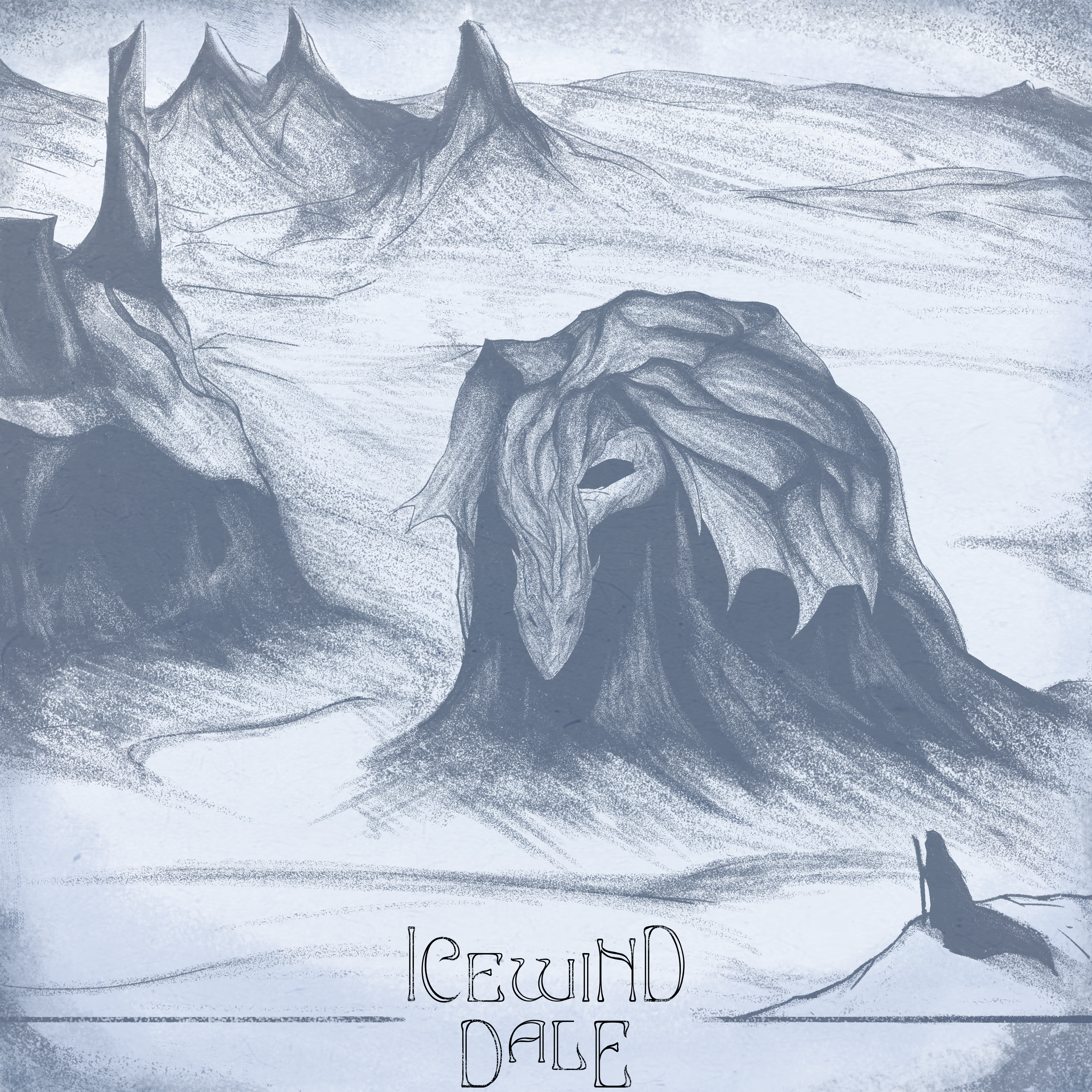
Hampus also made the beautiful cover art (depicting a dragon resting on a mountaintop) for the EP, and the Icewind Dale logo was made by a friend of mine, Tuukka:
Icewind Dale is named after the early-2000s video game series, which I didn’t play much but nonetheless feel nostalgia for. The first song I released under this name appeared on Heimat der Katastrophe’s HDK Dungeon-Synth Magazine #5 in late 2021. I also have a full album planned for release later this year on Heimat der Katastrophe. That earlier track and that planned album were made using a careful, slow method I described in an earlier post. To summarize, I would compose in notation software[1], export the MIDI, run the MIDI through a machine learning model I built to humanize the velocities (a tool I call midihum, which I first built around 2017 and then completely revamped in late 2023), move the humanized MIDI into a digital audio workstation (DAW), try dozens or hundreds of synth presets to choose the instrumentation, add atmospheric sounds, mix the entire thing, and iterate on all these steps. Completing a single track using this method can take me months, and a full album takes me well over a year.
There Were Some Kingdoms was an experiment in the opposite direction, where we tried to compose, record, and mix quickly, always favoring the first idea and accepting whatever imperfections came with working this way. When we set out to make the EP, I wrote that
The general ethos here is to use the first idea rather than trying to perfect things. I want to change the mindset away from “this song or album should be perfect” to “this song or album is just part of a fun broader project”.
I was inspired to work in this way by some very prolific artists, such as Guided by Voices, who have released over 40 albums in 39 years, and King Gizzard & the Lizard Wizard, who have released 27 albums in 13 years. Though my brother and I don’t make music at anything like their pace, I find it helpful to keep in mind what becomes possible when you don’t agonize over details. Another inspiration is the general point, often made in Silicon Valley, that speed matters and compounds (compare, for example, this post by Ben Kuhn). Much of what ended up on the EP also came from my brother’s and my shared love of 1990s indie rock: relatively simple chord progressions, fewer sections than in my other compositions, less counterpoint and variation, and shorter, more repetitive structures.
We made the EP over the course of about one or two months, but we spent only a few days playing and recording. So, at least in that respect, I would say we were successful. I also think the music on this EP is basically as good as my other music, although it is different and simpler in some ways.
Composition #
My brother and I settled on a pretty natural division of labor, where I wrote harmonic sketches for each piece (a chord progression for each section, a meter, a tempo, and a rough form) and my brother improvised melodies, countermelodies, and accompaniments over them when he came to visit me in Berlin. I really like composing music – I enjoy inventing harmonic progressions, and I enjoy coming up with the general shape of a piece. These activities are usually quick for me. I also enjoy writing melodies and accompaniments and doing the detailed work of creating variations, gluing passages together, and so on, though less so than I enjoy those former activities, partly because writing melodies, accompaniments, variations, and transitions usually takes me a lot of time. Clearly, one way to speed up the writing of melodies, accompaniments, and variations is to improvise. For these reasons, and because my brother, unlike me, can actually play music, this division of labor made sense for us.
For each song, I shared notes with my brother. For example, here is the sketch for the title track (the third track on the EP) as it appeared in my notes:
This piece is in e “Alpine” (melodic minor): E F♯ G A B C♯ D♯, in 6/4 time, at a brisk walking pace (115 BPM).
A reed synth melody playing over a lush voice synth accompaniment, using an e-Gaug-e-A progression repeated multiple times. A timpani beats a drum pattern on E, continuing throughout the song. (That means this piece needs to be recorded with a metronome.)
A new theme is played with an f♯-f♯-f♯-c♯-f♯-f♯-f♯-B progression, repeated once. Then, f♯-B is repeated once, followed by a caesura and …
Repeats (A)
Repeats (B), followed by a C♯7♭5-a-B7-e-A-e codetta
The sketch specifies the key, meter, tempo, a rough indication of the intended instrumentation, a harmonic progression for each section, and the overall form. It does not specify a melody, a bassline, or an accompaniment pattern. It also mostly does not specify a general mood or atmosphere. As I recall, the (A) section was a vague attempt to create a pleasing progression featuring an augmented triad, whereas the (B) section, with its pattern of a thrice-repeated chord launching into another chord, was inspired by a rock or indie song, though alas I can’t remember which one.
Each piece is built around a single mode. As I wrote before,
I write all my music in various synthetic scales, which I have rebaptized with more evocative names. I originally generated these scales via operations that Godfried Toussaint used in describing what he called Euclidean rhythms, and only then discovered that they already had names. What I call the Carpathian mode of the Montane scale is really Dorian ♭2, and what I call the Andean mode is the half-diminished. […] I like writing in synthetic scales because of their inherent dissonance.
These modes are further out than the common modal choices in dungeon synth, and much of the EP’s dissonance and mystery comes from using them. (If you feel you have exhausted the usual modal choices, the less-traveled modes are a cheap way to freshen the palette and introduce tension without changing anything else.) In this EP, we used what I call the Alpine mode (melodic minor) and the Carpathian mode (Dorian ♭2).
At least three of the sketches were inspired by specific songs. One, which we never had time to record, was loosely modeled on Robert Pollard’s “Slick as Snails”, in my view one of the greatest songs of all time. Another, which became “As If It Were a Spell”, took a melodic idea from The New Year’s “Simple Life”. A third, which became “Emerald Sky”, used a harmonic progression inspired by “Gauze” by Red Red Meat. These influences are invisible unless you know where to look, but I found that having a starting point for each song allowed me to work more quickly. Most of the other inspirations came from dungeon synth tracks and classical music, which I had taken notes on over the years and reused as they suited me.
Of the eight sketches I wrote, two were recorded and cut, two were never recorded, and four made the EP. The two that were recorded and cut were overdeveloped at the composing stage. Rather than giving my brother a simple structure and using a lot of repetition, I had included long, complex chord progressions and quite detailed instructions on instrumentation, mood, and melodic ideas. The best results came when I gave my brother simple sketches to develop while recording. So I found it better to restrain myself in that way, even if it felt counterintuitive. For example, when sketching out a song, a single two-chord interchange that repeats over a long period does not seem likely to be interesting, but when actually played and improvised over, it can produce several minutes of deeply interesting music.
Recording and Mixing #
We recorded in Reaper, using the same template for every track, so that we could begin every piece on the EP with the same instruments, effects, and master chain already set up. This saved me a fair amount of time and made starting a new track very cheap: we just loaded the template, and my brother could immediately try accompaniments and melodies based on the sketch composition, with nice-sounding synths that would be used for the final recording.
We used just a few software synths: Korg M1, Korg Polysix, and VirtualCZ, along with a harp sample from an Erang dungeon synth sample pack. I always used presets, only tweaking them to varying degrees and adding EQ and other effects.
One advantage of composing directly with the intended synth sounds, rather than composing first with fake orchestral soundfonts and choosing the synth sounds afterward (as I had usually done before), is that the question of whether a given chord progression and instrumentation work together gets answered the moment you play the first chord. Many melodies and accompaniments only sound good on certain instruments. With the old method, once the composition was finished, it could take a lot of work to find instruments that worked for every part, and I would sometimes have to go back and rewrite the parts themselves to fit the instrument I had settled on. Composing with the final sounds from the start avoids all of that.
The mixing was mostly done when setting up the template and when recording. When a take was good, we called it done. We worked six to eight hours or so a day over three or four days. Afterward, I would add atmospheric sounds and do some light editing and additional mixing and mastering, but mostly we just made sure we were happy enough with each track while recording.[2]
What I’d Like to See More Of in Dungeon Synth #
Dungeon synth grew out of the ambient intros and interludes of 1990s Norwegian black metal, but has since developed in many ways. Some features of dungeon synth, like its lo-fi pride, its interest in Tolkien and medieval imagery, and its romantic anti-modernism, derive from this origin. But since the second wave of the 2010s, much dungeon synth draws at least as much from early fantasy video game soundtracks, from medieval music, and from dark ambient music. If such music is largely synth- and/or sample-based, and is in some way lo-fi or artificially orchestrated and produced, and is in some way fantastically or historically nostalgic, we can count it as dungeon synth. It doesn’t matter, in my mind, what forms, melodies, harmonies, or rhythms are used, provided there is the right sound and atmosphere.
Dungeon synth is a lovely genre to make music in because it is so accessible and flexible. All you need is a computer, some software, and ideas, and that alone allows you to make incredibly evocative and wide-ranging music. That there are hundreds of dungeon synth subgenres shows how much room the genre has for experimentation. Despite this diversity, there is a lot of dungeon synth that I would like to hear but that doesn’t yet exist. (That is one reason why I am making dungeon synth.) Here are a few directions I would like to see more of, in the hope that someone will be inspired to explore them:
- Harmonic adventurousness. Most dungeon synth works in a handful of common modes, using fairly standard chord progressions, little chromaticism, and few modulations. I would like to hear more dungeon synth inspired by the Romantic and late-Romantic harmonic languages, for example, those of Sibelius, Bruckner, Vaughan Williams, Wagner, and Scriabin. Or even: where is my twelve-tone dungeon synth? Where is my whole-tone scale dungeon synth? A few dungeon synth artists are fairly harmonically advanced and seem to draw on classical music, such as Umbría and (more Baroque-like) Frog Concert. But these are rare; I wish there were more of them.
- Longer forms with proper thematic development. Most dungeon synth consists of a single loop repeated endlessly, with instruments coming in and out and mild variation here and there. There are very few pieces that resemble anything like a sonata, a fugue, or a theme and variations. I can’t think of anything in dungeon synth resembling the swan-call theme at the end of Sibelius’s Fifth Symphony, which reaches a grand, otherworldly feeling of arrival, of having come home, that is impossible to evoke with a looped melody. To evoke that feeling, you need to develop themes across time, transform and vary them, and return to them after contrasting with other material.[3]
- More danceable dungeon synth. By this, I mean dungeon synth that is rhythmical and energetic enough to play in a bar, or in the afternoon at a festival, with some groove, a tempo that is not too slow, and more focus on percussion and melody than on atmosphere and ambience. Inlustris is one example of this type of dungeon synth artist, even though arguably it is not strictly dungeon synth. Umbría has a few more energetic pieces, and so do Fief and Flickers from the Fen. A friend and I have hosted a dungeon synth radio show called Summoned Sounds on Refuge Worldwide; our November 2024, April 2025, and September 2025 episodes have songs in the bar-friendlier end of dungeon synth and may be of interest to anyone curious about this direction. Unlike the directions proposed above, this one would probably be harmonically simpler and more repetitive than the current typical dungeon synth song, not less so. But let a thousand flowers bloom!
A few other dungeon synth artists I think have done interesting and forward-thinking work are Chaucerian Myth, Elyvilon, and Malfet.
To be clear, there is nothing in dungeon synth I want less of, and I am not complaining about the dungeon synth that exists today; I just want these other things alongside what exists today. My one related wish is that more dungeon synth artists knew more about music theory and composition. I often hear dungeon synth that is inspired in some ways but sounds harmonically and melodically quite awkward and lifeless, in ways a trained composer could easily improve on. More knowledge of music theory and composition would help a lot of dungeon synth artists make whatever kind of dungeon synth they want to make.
I myself have a few new projects in mind. One is an ambient dungeon synth record, something like a dungeon synth version of Brock van Wey’s White Clouds Drift On and On, an album I’ve kept coming back to ever since it came out in 2009. Another is a Diablo 2-inspired project I have been thinking about for a while, with one album for each of the seven classes, and each class’s character and backstory serving as the starting point for a harmonic language and instrumentation. The third is a dungeon synth symphony, carefully composed in the manner of a Romantic symphony, using the slow method from my earlier Icewind Dale work. I mention these here mostly to encourage myself to carry them out.
Footnotes #
I used to compose in MuseScore, but I now compose in Dorico, because I got sick of all the bugs. ↩︎
The mastering chain was very simple. I used Cockos ReaVerb (with an impulse called “Small Church”, which I’m not sure where I got) on the reverb bus, Waves PuigChild 670 for compression, u-he Satin for tape saturation, and Klanghelm VUMTdeluxe to turn the low end mono. ↩︎
One reason why dungeon synth is so loop-heavy may be that most people compose in DAWs, where looping is the path of least resistance. If more dungeon synth were composed in notation software, we would hear more themes and more variations of them, because looping or repeating is fairly awkward in notation, while writing new material feels very natural. I don’t know what the best solution is here, but it is certainly possible to create dungeon synth with more complex forms in DAWs too, if one consciously tries to do so. ↩︎